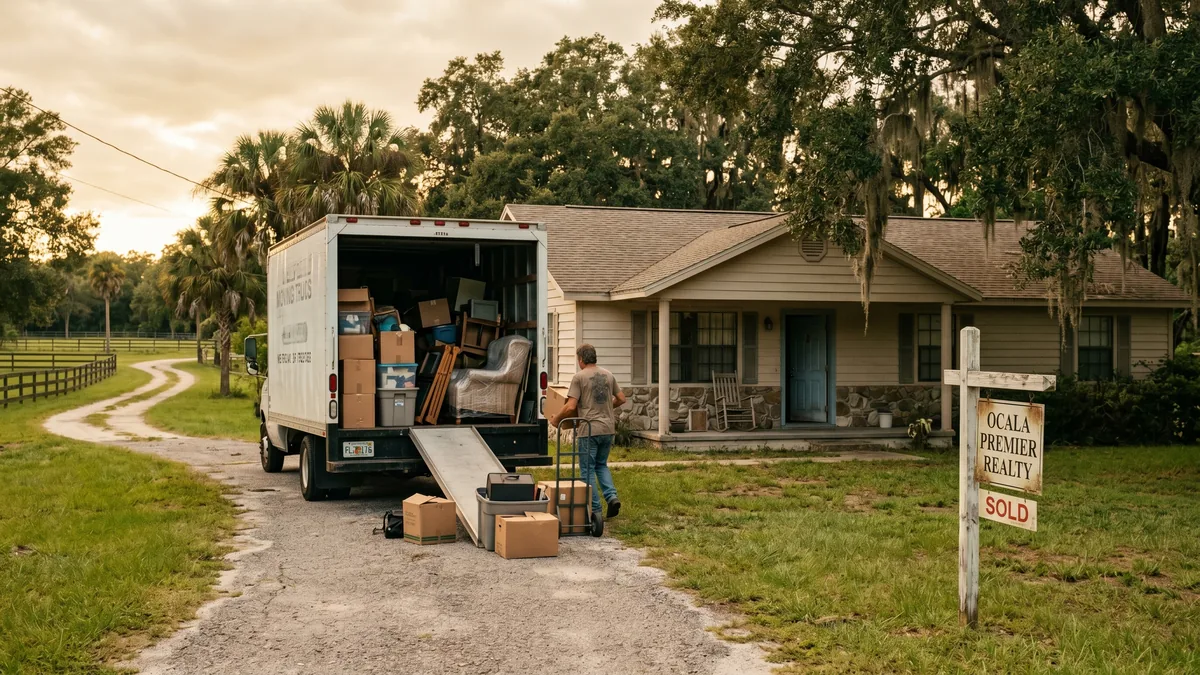
Why People Are Leaving Ocala (Honest Take)
Why people are leaving Ocala is real, but the metro still gains 318 people/week net (442,660 pop). The full picture behind the YouTube videos.
If you've spent any time on YouTube researching Ocala, you've seen them, videos titled "Why People Are Leaving Ocala" with 30,000+ views. They're real signals. The complaints they raise are real. But they're also a small slice of a metro that's still gaining 250+ people per week net of departures.
Here's the honest accounting: what people are leaving for, what people are arriving for, and what should and shouldn't change your mind.
Why they're leaving
1. Infrastructure strain.
This is real and quantifiable. Marion County added 16,567 residents from July 2023 to July 2024 alone. Roads (especially SR 200, the SW commercial corridor) are visibly more congested. Retail capacity is catching up but lagging in newer areas like Marion Oaks. Schools are at record enrollment. This is the legitimate critique.
2. Heat.
Ocala is inland. No coastal sea breeze. Summer afternoons (June-September) are genuinely punishing, humid, still, hot. Northerners and Midwesterners often underestimate this. Folks who left for North Carolina or Tennessee will tell you, "I just got tired of summer being eight months long."
3. Limited white-collar professional density.
The metro's economic anchors are healthcare, manufacturing, logistics, and equestrian. White-collar professional jobs are limited. If you're under 40 and need an in-office role in tech/finance/consulting, you're commuting to Gainesville (45 min) or Orlando (90 min), or you're remote. Some leave when they can't find a peer professional community.
4. Insurance and HOA fee creep.
Homeowner insurance went up across Florida. HOA fees in master-planned communities have climbed faster than residents expected. Combined with property tax increases as values rose, fixed-income retirees are sometimes priced out of the home they bought five years ago.
5. The social problem (specific to younger residents).
Ocala has an older median age (47.3 vs. 39.2 nationally). Younger millennials sometimes report difficulty building peer social networks, especially if they came from Austin, Denver, or Brooklyn.
Why they're arriving
Despite the leavers, Ocala remained the #1 fastest-growing US metro for the second consecutive year in the Census Vintage 2025 release (March 2026). Net migration was +13,755 in the most recent year, slower than peak but still leading the country by percentage. The arrivers are responding to:
- Affordability, median home 33% below US, cost of living 12% below.
- Lower density, refugees from Tampa, Orlando, and Miami who don't want to give up Florida but want less congestion.
- Equestrian industry, national/international buyers in the $1M+ tier.
- The Villages spillover, buyers who want a Villages-style community but at lower cost or with more demographic mix.
- Remote-work arbitrage, Tampa or Miami salaries, Ocala cost of living.
The honest verdict
If you're moving to Ocala expecting it to feel like Charlotte or Nashville, modern white-collar metro, full of 30-somethings, restaurant-of-the-month, you'll leave. That's not what it is.
If you're moving to Ocala expecting "affordable Florida town with horse country, real downtown, master-planned 55+ options, and weather you can handle for 9 months," the data supports staying. The leavers are the ones who got the wrong product. The arrivers know what they're buying.
This is the calculus the YouTube doom-videos don't make. They're not wrong about the complaints. They're missing the comparison frame.
Is Ocala right for YOU?
Five questions, three matched neighborhoods, clear recommendation. Free.
Take the quiz →Frequently asked questions
Why are people leaving Ocala Florida?
Is Ocala still growing despite people leaving?
What infrastructure problems does Ocala have?
Is Ocala too hot to live in?
Who should NOT move to Ocala?
Want a custom version of this analysis for your situation?
The Personalized Neighborhood Report ($49) builds on this data with your specific budget, household, and school needs. 48-hour delivery, 30-day money-back.
Get the report →